On Dismantling Executive Branch Coercive Power
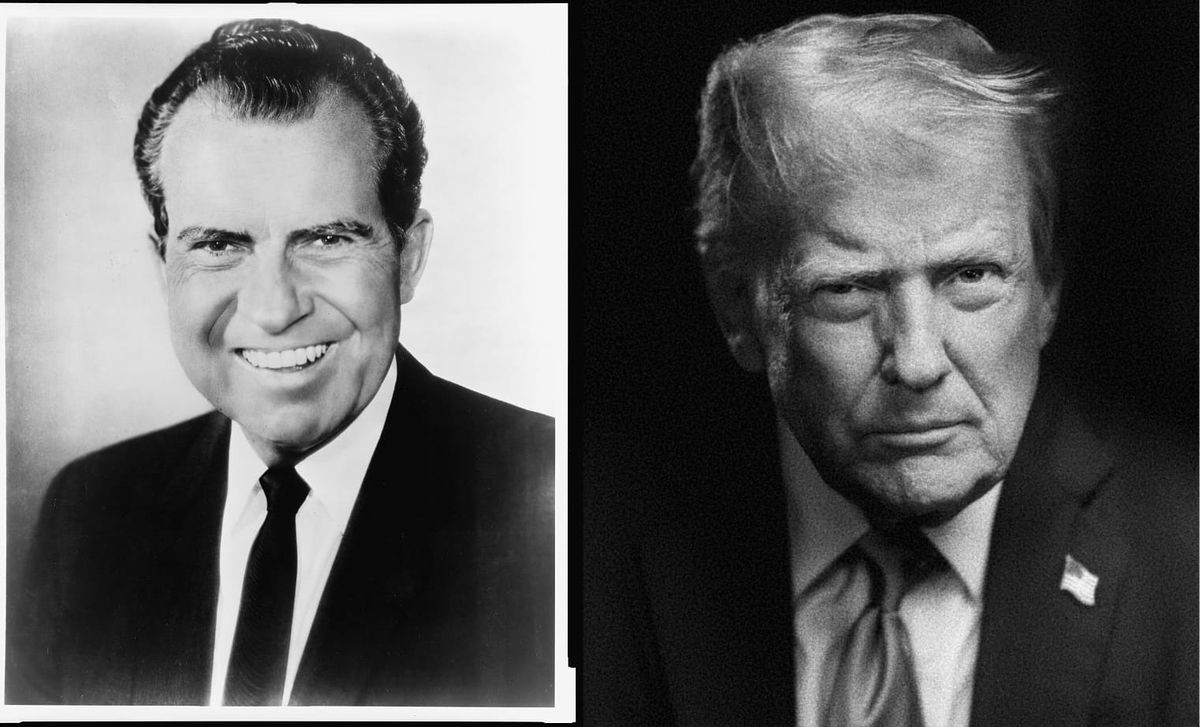
Three legislative attempts to future-proof the Republic against another Nixon—or another Trump—and why each failed or will fail. Nothing less than a constitutional amendment will do the trick.

Three legislative attempts to future-proof the Republic against another Nixon—or another Trump—and why each failed or will fail. Nothing less than a constitutional amendment will do the trick.
Publisher's Note: This special edition of The Republic Sentinel is being provided to a general audience in addition to subscribers as part of an effort to broaden the conversation about how America's government must change in a post-Trump era.
In December 1973, with the Watergate cover-up unspooling around him, Senator Sam Ervin of North Carolina introduced a bill to make the Department of Justice independent of the President. He was certain Congress had the power to do it. “There is not one syllable in the Constitution,” he insisted, “that says that Congress cannot make the Justice Department independent of the President.”1 Fifty-two years later, the question Ervin thought he had settled is once again the most urgent in American government—and the answer has gotten worse, not better, for those who share his goal.
This piece makes a single argument, built from three worked examples. The argument is that you cannot future-proof the executive branch against an unscrupulous President by ordinary statute.
Not because the reformers are unserious—they are often the most serious people in the room—but because every statutory route to the goal runs into one of three walls: the President's removal power, the Appointments Clause, or, in the newest and most audacious move, the executive's asserted authority to declare the statute void and decline to enforce it. The three examples are Ervin's failed 1973 bill, Senator Cory Booker's 2025 MARSHALS Act, and Representative Jamie Raskin's sprawling 2026 Protecting Our Democracy Act—read against the Office of Legal Counsel opinion, signed April 1, 2026, that declared the Presidential Records Act unconstitutional and unenforceable in its entirety.
Taken together they form a kind of natural experiment. Each reform attacks the problem of presidential lawlessness from a different angle—independence, relocation, transparency—and each is defeated by a different mechanism. The pattern that emerges is the point: the walls are not bugs in the drafting. They are features of Article II as the current Supreme Court reads it.
I. Ervin's Quest
Begin with the man who saw it most clearly and still got it wrong. Sam Ervin understood, better than almost anyone of his generation, that the office of Attorney General is a creature of statute—created by the Judiciary Act of 1789, not by the Constitution—and that the Department of Justice itself did not exist until 1870. “All powers of the Attorney General and of the Department of Justice flow from acts of Congress,” he observed. “What Congress gives, Congress can take away.”2
From that premise, Ervin drew a structural conclusion and wrote it into S. 2803 (93rd Congress), introduced December 12, 1973. The bill would have lifted the Department out of the executive departments entirely, fixed the Attorney General's term at six years, and protected the office from removal except “for neglect of duty or malfeasance in office.”
Ervin grounded the design on the independent-agency line of cases—Humphrey's Executor v. United States (1935) and Wiener v. United States (1958)—and analogized the new DOJ to the Government Accountability Office and the regulatory commissions, agencies that “execute certain laws independently of the President.”3
It was an elegant bet. It was also, by the testimony of the sitting Attorney General, an impossible one.
When the Ervin Subcommittee on Separation of Powers held its 1974 hearings, Attorney General William Saxbe told the senators that genuine independence for the Department “could not be done without a constitutional amendment.”4
That single sentence is the hinge of this entire piece.
Saxbe was not making a policy objection. He was identifying a structural ceiling: a statute can rearrange the furniture of the executive branch, but it cannot evict the President from his constitutional authority to control the officers who execute federal law.
The fragility of Ervin's design lay in its load-bearing element—a single removal-protection clause. The independence of the entire Department rested on the proposition that an Attorney General could be insulated from at-will presidential removal. In 1974 that proposition had the backing of Humphrey's Executor. Today it is a doctrine in retreat.
In Seila Law LLC v. CFPB (2020), the Court held that Congress may not insulate the single head of an executive agency from presidential removal, narrowing Humphrey's Executor to multimember bodies exercising no substantial executive power. A criminal prosecutor is the very archetype of an officer wielding core executive power. Ervin centered his proposal on the one clause the modern Court has spent two decades dismantling.
The deeper lesson of S. 2803 is not that it failed—it never reached a floor vote—but why it had to be built the way it was.
Ervin could not simply declare the Attorney General free of presidential control; the Take Care Clause and the Appointments Clause stood in the way. So he reached for the only tool a statute affords: a for-cause removal limitation, plus a fixed term, propped against a line of precedent. Every load the structure had to bear was transferred onto authorities the Constitution assigns the President, secured by a clause a later Congress could repeal and a later Court could read away. The bill was a fifty-year-old preview of the trap every successor would fall into.
II. Booker's Angle: Protecting Judges
Fast-forward to May 22, 2025. With federal judges reporting threats and at least one warning that the President might order the U.S. Marshals to stop protecting the bench, Senator Cory Booker—joined by Senators Schumer, Padilla, Schiff, and Wyden, with a House companion led by Representatives Swalwell, Raskin, and Johnson—introduced the MARSHALS Act (S. 1873).5 Note the name in bold: the lead House sponsor of the bill we will reach in Part III was a cosponsor of the bill in Part II. The reformers are largely a single, coherent group attacking the same problem from successive angles—which is exactly what makes their collective failure instructive rather than accidental.
The MARSHALS Act tris to solve the judge-protection problem by physically relocating the Marshals Service. It would amend Title 28 to transfer the USMS out of the executive branch and establish it as a bureau within the judicial branch, with the Director and each district marshal appointed by the Chief Justice of the United States in consultation with a governing Board.6 Where Ervin tried to insulate an executive officer in place, Booker tried to move the officers across the street and hand the keys to the Chief Justice.
This is a more aggressive move than Ervin's, and it fails at a different point: the Appointments Clause.
The Marshals are not clerks; they carry weapons, make arrests, and use force when required. They are quintessential “Officers of the United States” under Buckley v. Valeo (1976), and principal officers who execute the laws must, under Edmond v. United States (1997) and United States v. Arthrex (2021), sit in a chain of supervision that runs to the President. One of the current Court's most recent Appointments Clause decision, Kennedy v. Braidwood Management, Inc. (2025), sharpened exactly that framing: the constitutional touchstone is whether the officer's chain of command runs to the President.7 A statute that makes the Chief Justice the appointing authority for an armed federal law-enforcement service—and routes that service's supervision into the Judicial Branch—collides head-on with that requirement.
Here is the part that makes the MARSHALS Act the cleanest example of the three. It is not merely vulnerable; it is unfixable by amendment within the statutory form.
Every plausible repair—making the Director Senate-confirmed, restoring presidential removal, vesting appointment in a department head—reattaches the Marshals to the executive chain of command and thereby restores the precise political control the bill exists to sever. The constitutional defect and the legislative purpose are the same object viewed from opposite sides. You cannot cure one without destroying the other. The bill is, in this sense, perfectly self-defeating: its unconstitutionality is load-bearing.
That property—a reform whose every viable redraft defeats its own purpose—is the tell that you have hit a constitutional ceiling rather than a drafting problem. A drafting problem has a better draft. A structural ceiling does not. The MARSHALS Act has no better draft, because the thing it wants to do—sever an executive force-wielding agency from presidential control—is the one thing Article II, as currently construed by federal courts, forbids a statute from doing.
III. Raskin's Wall, and the Solvent the Executive Built to Dissolve It
We now come to the most sophisticated attempt of all—and to the most brutal demonstration of the thesis.
On May 14, 2026, Representative Jamie Raskin (D-MD) reintroduced the Protecting Our Democracy Act (H.R. 8831), the descendant of the 2021 package the House once passed.8 It is enormous—thirty-eight titles across four divisions—and it is, crucially, built almost entirely to avoid the walls that stopped Ervin and Booker.
Raskin plainly learned the lesson of the first two examples. The bill does not try to relocate the Department of Justice or insulate the Attorney General from removal. It does not move an armed agency into the Judicial Branch. Instead it works around the Article II core: it compels disclosure, mandates reporting, tolls statutes of limitations, creates civil-enforcement hooks, and bans the presidential self-pardon. Where it touches prosecution at all—Title XIV's “Investigative Integrity Protection,” which would force a sworn judicial inquiry when the government moves to dismiss a prosecution of the President—it routes the oversight through an Article III court rather than trying to detach the prosecutor. It is the work of people who studied the ceiling and tried to legislate just beneath it.
For a generation, that lower altitude—transparency rather than control—was assumed to be safe. Congress's power to make the executive branch document and disclose what it does was the one tool no one seriously thought a President could escape. The reasoning was simple: even if you cannot tell the President whom to prosecute, you can surely require that the record of what he did survive him.
For a generation, transparency was assumed to be the safe ground. That assumption died on April Fools' Day, 2026.
On that date, Assistant Attorney General T. Elliot Gaiser, head of the Office of Legal Counsel (OLC) at the Justice Department, issued a fifty-two-page opinion concluding that the Presidential Records Act—the post-Watergate statute that, for the first time in American history, made presidential records public property and required their preservation—is facially unconstitutional, inseverable, and void in its entirety, such that “the President need not further comply with its dictates.”9
The opinion's reasoning is not confined to records. It is a general-purpose weapon, and it is aimed directly at proposal's like Raskin's.
Gaiser's argument runs in two interlocking steps.
First, Gaiser contends that Congress's power to compel information from the President is not enumerated; it is an implied auxiliary of the legislative power, and under Trump v. Mazars USA, LLP (2020), demands directed at the President must clear a heightened bar requiring a specific, articulated legislative purpose. A statute that compels disclosure prospectively and in perpetuity, untethered from any contemporaneous legislative need, fails that test by design—it is, in the opinion's words, a “sledgehammer” where the Constitution permits only a “scalpel.”
Second, and more sweeping, Gaiser asserts that the Presidency is “a constitutional office that Congress did not create and that Congress cannot abolish,” and therefore cannot regulate the way it regulates the statutory agencies it builds. That logic, the opinion makes explicit, reaches not only the President but “the President's immediate staff, or a unit or individual of the Executive Office of the President whose function is to advise or assist the President,” because those advisers “exist by operation of the Constitution, not by the grace of Congress.”10
Now lay that template over H.R. 8831 and watch the “safe” provisions disintegrate.
The bill's tax-transparency title would compel every future President to file ten years of returns—a standing, perpetual disclosure mandate on the office itself. Its visitor-log provision would force a rolling public database of who enters the White House. Its disclosure-of-Presidential-Emergency-Action-Documents provision reaches the most sensitive internal contingency planning of the office. And, most strikingly, its BEACON Act title would install a statutory Inspector General inside the Executive Office of the President.
On that last provision the Gaiser opinion does not merely supply a theory by analogy; it cites OLC's own 1996 conclusion that an EOP Inspector General “would be unconstitutional, even if the Inspector General would be subject to the authority, direction, and control of the President.”11 And here the detail that ought to give Raskin and his supporters the longest pause: that 1996 opinion was written not by some predecessor of the current administration but by President Clinton's Office of Legal Counsel, in a memorandum signed by Deputy Assistant Attorney General Randolph D. Moss—later OLC's chief under Clinton, now a federal judge.
The view that Congress cannot plant an inspector general inside the President's own office is not a partisan weapon forged for this fight; it is settled, cross-administration executive-branch doctrine, held by Democratic and Republican OLCs alike. The single most structurally ambitious transparency provision in Raskin's bill is one the executive's own legal canon—written by the reformers' own side—had already declared dead, three decades before the bill was introduced.
And here the provenance matters more than it first appears.
That 1996 memo was not the product of a hostile or like-minded administration straining to expand presidential power for its own convenience. It was issued by President Clinton's OLC, authored by Randolph Moss—a Democratic-administration lawyer who would later be appointed to the federal bench by President Obama, and who in 2000 wrote the companion OLC opinion concluding that a sitting President cannot be indicted.12
The proposition that Congress cannot plant an inspector general inside the President's own office is therefore not a partisan invention of the current Justice Department. It is a bipartisan executive-branch consensus, resting on the same Article II premise—that Congress may not impede the President's performance of his constitutional functions—that runs through both Moss's work and Gaiser's. When the sitting administration reaches for that memo, it is not manufacturing a theory; it is collecting a debt that the reformers' own side helped underwrite.
The crucial move—the one that separates this example from the first two—is the remedy.
Ervin's bill would have been tested in court; Booker's would be tested in court. Gaiser's opinion needs no court. It ends by invoking the President's asserted authority to “decline to enforce statutes he views as unconstitutional.”13
The PRA was not struck down by a judge. It was nullified by a memorandum. And the same mechanism is available, the moment the ink is dry, against any provision of H.R. 8831 that compels the President or his office to disclose anything. The reformers' last safe harbor turns out to be defended only by the executive's willingness to respect it—which is precisely the willingness the reform was meant to stop relying on.
One must be precise here, because precision is what makes the argument durable.
Gaiser does not claim Congress can never obtain presidential information. The opinion carefully preserves the targeted, purpose-specific subpoena and the give-and-take of the accommodation process; its quarrel is with the standing, prospective, suspicionless mandate. That refinement does not rescue Raskin's bill—it indicts it, because the disclosure titles that form the bill's spine are precisely standing, prospective mandates on the office. The drafters chose the one form of transparency the opinion was built to defeat. But it does mean the honest version of the thesis is narrow and therefore strong: the claim is not that Congress is powerless, but that the standing structural reforms—the kind that actually future-proof against a future officeholder—are exactly the kind a statute cannot secure.
IV. Three Reform Efforts, Same Doomed Outcome
Step back and the architecture of the failure comes into view.
Ervin was stopped by the removal power. Booker was stopped by the Appointments Clause. Raskin is stopped—preemptively, without litigation—by the executive's claimed power of constitutional self-help. Three different mechanisms, but a single underlying principle: under the unitary-executive jurisprudence the Court has built from Seila Law through Trump v. United States (2024), the President's authority over the execution of federal law—and now over the very information that would document that execution—is treated as a constitutional core that ordinary legislation cannot reach.14
This is why the “future-proofing” ambition is the part that fails most reliably.
A statute aimed at a present abuse can sometimes work, because it can be specific: a targeted subpoena, a particular appropriations rider, a narrow disclosure tied to identified legislation. But future-proofing requires exactly what the doctrine forbids—a standing, prospective, suspicionless constraint that binds the office regardless of who holds it.
Ervin's permanent independent DOJ, Booker's permanent relocation of the Marshals, Raskin's permanent disclosure regime: each is structural and forward-looking by necessity, and each is therefore maximally exposed. The more a reform tries to bind the office rather than the officer, the more squarely it lands in the zone the Supreme Court and the OLC have walled off.
There is a grim irony threaded through all three episodes. Sam Ervin invoked Watergate to argue that the Department must be made independent. The Gaiser opinion invokes Watergate from the other direction—treating the post-Nixon Presidential Records Act as the historical aberration to be undone, a “minor crack” that became a “major fissure.” The same scandal that launched the reform project is now cited as the reason to dismantle it. Watergate produced the statutes; the unitary-executive counter-revolution is unwinding them one by one.
The defect in every statutory reform is that it must be interpreted and enforced by an executive branch the reform is designed to constrain. Ervin's independent Attorney General would still have been nominated by the President. Booker's Marshals would still, in any constitutional redraft, answer up the executive chain. Raskin's disclosure mandates are enforced—or declined—by a Department of Justice the President controls, under constitutional opinions written by an OLC the President controls. And the institutional convictions that doom provisions like the EOP inspector general do not change with the party in power: it was Clinton's OLC, not Trump's, that first declared such an office unconstitutional. A statute that depends on the good faith—or even the settled constitutional self-understanding—of the official it restrains has not restrained him; it has merely written down a request.
V. The Only Wall That Holds
The thing that distinguishes a constitutional amendment from every statute surveyed here is that it cannot be narrowed by Seila Law, evaded by the Appointments Clause, or declared void by an OLC opinion. It is not an implied auxiliary of some enumerated power that a court can cabin; it is the supreme law the courts are bound to apply. It does not depend on the President's willingness to comply, because it is not the President's to interpret away. The text changes, and the executive's lawyers must work within it rather than around it.
This is not a counsel of despair about the reformers' instincts—those instincts are sound, the people who've offered them were and are loyal to the constitutional Republic, and the threat they perceive is real and present. It is a counsel about the choice of instrument.
Saxbe said it to Ervin in 1974: it could not be done without a constitutional amendment. The MARSHALS Act proves it again in 2025, as it is unfixable in statutory form. And the Gaiser opinion proved it a third time in 2026, by showing that even the transparency fallback can be dissolved by memorandum. Three statute-based reform proposals three decades apart offered in the same spirit--all incapable of achieving their intended goal, primarily due to a defective constitutional design made worse by multiple Supreme Court decisions and the base desire for maximum power by successive American chief executives and those serving them.
The reformers keep building walls because the danger is real. The walls keep coming down because they are made of the wrong material. There is one material the executive cannot dissolve, because the executive does not own it: the text of the Constitution itself. If the Republic is to be future-proofed against another Nixon—or another Trump—that is the only quarry left to build from.
A page of history, Justice Holmes wrote, is worth a volume of logic. The Gaiser opinion quotes him to argue that two centuries of presidential control over records should defeat the modern statute. The same page of history, read forward instead of backward, teaches the opposite lesson: that for fifty years reformers have tried to bind the office by statute, and for fifty years the office has slipped the knot. The logic of that history points to the amendment as the knot that is unbreakable. In a future edition of The Sentinel, I'll lay out the details of what such an amendment should like.
Notes & Sources
- Hearings before the Subcommittee on Separation of Powers, Senate Committee on the Judiciary, Removing Politics from the Administration of Justice, 93rd Cong. (1974) (statement of Sen. Sam J. Ervin, Jr.). ↩
- Id. (opening statement of Sen. Ervin). On the statutory origins of the office, see Judiciary Act of 1789, ch. 20, § 35, 1 Stat. 73, 92–93; and on the 1870 creation of the Department, see National Archives, “An Act to Establish the Department of Justice” (16 Stat. 162). ↩
- S. 2803, 93rd Cong. (1973) (Ervin). Removal protection rested on Humphrey's Executor v. United States, 295 U.S. 602 (1935), and Wiener v. United States, 357 U.S. 349 (1958)—the line narrowed in Seila Law LLC v. CFPB, 591 U.S. 197 (2020). ↩
- AG William B. Saxbe's response is recorded in the 1974 Separation of Powers hearings, supra note 1. Contemporaneous account: see coverage of the Ervin Subcommittee hearings on S. 2803 and S. 2978. ↩
- S. 1873, 119th Cong. (2025) (MARSHALS Act), introduced May 22, 2025; House companion H.R. 3607 (Swalwell, Raskin, Johnson). ↩
- Sponsors' description and judge-protection rationale: Booker press release, May 22, 2025. ↩
- Appointments Clause framework: Buckley v. Valeo, 424 U.S. 1 (1976); Edmond v. United States, 520 U.S. 651 (1997); United States v. Arthrex, Inc., 594 U.S. 1 (2021). The chain-of-command framing appears in Kennedy v. Braidwood Management, Inc. (2025) (U.S. Reports pagination—reported as 606 U.S. 748—should be verified against the bound volume before citation in print). ↩
- H.R. 8831, 119th Cong. (2026) (Protecting Our Democracy Act), introduced May 14, 2026 (Raskin). Predecessor: H.R. 5314, 117th Cong. (2021). ↩
- Office of Legal Counsel, Constitutionality of the Presidential Records Act, 50 Op. O.L.C. __ (slip op. Apr. 1, 2026) (Gaiser, A.A.G.) (concluding the Act is “unconstitutional, and the President need not further comply with its dictates”). On the PRA generally, see National Archives, Presidential Records Act, 44 U.S.C. §§ 2201–2209. ↩
- Gaiser, supra note 8, slip op. at 1, 17–26, 31–32 (enumerated-powers and EOP-adviser reasoning), applying Trump v. Mazars USA, LLP, 591 U.S. 848 (2020) (the “scalpel/sledgehammer” and four-factor framework). ↩
- Gaiser, supra note 8, slip op. at 49, citing Memorandum from Randolph D. Moss, Deputy A.A.G., O.L.C., Re: Inspector General for the Executive Office of the President (July 24, 1996). Moss authored the memorandum during the Clinton administration and later served as Assistant Attorney General heading OLC (1998–2001); he now sits on the U.S. District Court for the District of Columbia. The opinion's cross-administration provenance is the point: the unconstitutionality of an EOP inspector general is a position OLC has held under presidents of both parties. ↩
- Moss joined OLC as Deputy A.A.G. in February 1996 under the Clinton administration, later serving as Acting A.A.G. (1998–2000) and A.A.G. (2000–01); he was appointed to the U.S. District Court for the District of Columbia by President Obama in 2014. See Randolph D. Moss (Fed. Judicial Ctr. biographical directory). For the 2000 indictment opinion, see A Sitting President's Amenability to Indictment and Criminal Prosecution, 24 Op. O.L.C. 222 (Oct. 16, 2000) (Moss, A.A.G.). ↩
- Gaiser, supra note 8, slip op. at 52, citing Issues Raised by Provisions Directing Issuance of Official or Diplomatic Passports, 16 Op. O.L.C. 18, 32 (1992). ↩
- Unitary-executive trajectory: Seila Law, supra note 2; Trump v. United States, 603 U.S. 593 (2024). ↩
Citation note. U.S. Reports pinpoint pages for Seila Law, Mazars, and Trump v. United States are given as commonly reported.