Restoring the Republic: A Legislative and Constitutional Roadmap
Whether the governmental system that comes after Trump is gone is better or worse than what came before him is up to us.

In his essay “To the Citizens of the State of New York” on November 1, 1787, the Anti-Federalist known by the nom de plume of “Brutus” offered this prescient observation and warning:
Those who have governed, have been found in all ages ever active to enlarge their powers and abridge the public liberty.
It’s true that Trump is hardly the first president to engage in demonstrably unconstitutional acts. Just consider these non-exhaustive examples:
- John Adams’s embrace of the Alien & Sedition Acts
- Andrew Jackson’s mass deportation of native peoples west of the Mississippi
- Abraham Lincoln’s suspension of habeas corpus
- Woodrow Wilson’s persecution of German Americans during World War I
- Franklin Delano Roosevelt’s internment camps for Japanese Americans
- Harry Truman’s Cold War federal employee “loyalty” program (including, later, the targeting of gays under Dwight Eisenhower)
- Eisenhower’s sanctioning of the FBI’s infamous COINTELPRO
- John F. Kennedy’s authorization of surveillance of Martin Luther King, Jr.
- Lyndon Johnson’s surveillance and political repression of the Vietnam era anti-war movement
- Richard Nixon’s total subversion of the 1972 presidential election process.
Earlier this year, I published a book about many of these episodes. And if you think that the mid-1970s era of congressional investigations of these abuses brought them to an end, you’d be mistaken. Every president from Reagan through Trump has misused government surveillance and policing powers, some violating the constitutional rights of Americans at scale.
For much of the 20th century, the threat of Soviet communism was used to justify surveillance and political repression targeting individuals or groups the federal government believed (rightly or wrongly) to be acting as de facto agents of Moscow.
As the Cold War waned and finally ended in the late 20th century, the threat of foreign-origin terrorism became the federal government’s excuse to conduct surveillance and political repression. The targeting of Arab and Muslim Americans from the 1970s onward, beginning with Palestinian intellectuals and groups, culminated in the post-9/11 enactment of the draconian PATRIOT Act. Later the Foreign Intelligence Surveillance Amendments Act came into force. These laws allow the government to collect, store, and–in the case of the FISA Section 702 program– search the communications of millions of innocent Americans without probable cause-based warrants, as the Fourth Amendment requires.
The constitutional violations that occurred in the hundred years prior to Trump’s arrival on the political stage were monstrous and life altering for the victims. With the exception of small reparations paid to the Japanese-American survivors of World War II internment, there has been no recompense made to hundreds of thousands of the victims of other episodes of government surveillance-enabled repression.
As I note in The Triumph of Fear, prior to Trump’s tenure in office, only two American presidents--the Roosevelts--created a personal “enemies list" and used government power to act against those on it. Theodore and Franklin Roosevelt's actions were outrageous, but the number of individual targets of their surveillance was relatively small.
One of their Republican successors went much further.
Richard Nixon’s total subversion of the 1972 presidential election process was carried out in secret, a virtual carbon copy of the FBI’s COINTELPRO but run against the Democratic Party establishment and its most likely presidential nominees. The bungled Watergate burglary led to the exposure of Nixon’s illegal activities. The subsequent Congressional investigations and House Judiciary Committee’s impeachment votes against him forced him to resign.
The prior abuses I cited above severely damaged – but did not destroy – the constitutional order. In the Nixon episode, our constitutional system survived its worst stress test to that point.
In the Trump 2.0 era, his misuse of executive orders, lawfare, and a cult-like hold on the House and Senate GOP majorities have shattered virtually all available means of stopping his authoritarian power grab.
Almost a year into his second term, Trump's misconduct has revealed a now self-evident truth: his actions are so severe in their scale and consequences that they present a direct threat to the very survival of what's left of the constitutional Republic.
Trump's targeting of his personally disfavored law firms, universities, ethnic communities (Latinos and Palestinian-Americans in particular), and members of the opposing political party, as well as the militarization of immigration enforcement at scale, are without equivalent historical precedent.
The most significant Trump governmental "innovation" is his wholesale cleansing of career civil servants at the Justice Department who refuse to engage in politically motivated prosecutions.
The multiple reports of his demands for absolute loyalty–not simply from political appointees, but from the remaining career civil servants–reveal an attempt to create a federal workforce loyal to one would-be dictator instead of the Republic.
Trump's existing and likely future damage to the constitutional order has been made possible in no small part by a post-Revolution governing structure that contained within it the very means to destroy it.
Flawed From The Beginning: Our Constitutional System
The Framers’ key assumption was that the fragmented nature of a federal republic would itself act as a safeguard against centralized government tyranny. The principle of federalism (operationalized via the Tenth Amendment) and the concept of decentralized federal power (via the presidency, Congress, and federal courts) were embedded within the Constitution to achieve that goal. The Founder's hope was that such a system would make the kind of political repression they fought to free themselves from impossible in the new United States.
That construct and the assumptions underpinning it were demolished by the Federalist proponents of the Constitution, who themselves would become the oppressors of their political opponents when they controlled the federal government only a decade after the Constitution’s ratification.
Most Americans have been taught that the Constitution empowers the judicial and legislative branches to check a rogue executive. It is yet another national myth.
Federal courts have never had their own coercive policing power to compel executive branch officials to obey the Constitution or federal statutes. Even the U.S. Marshals Service, which by statute is charged with protecting federal court houses and staff, answers not to the federal judiciary but to an Executive branch political appointee: the Attorney General.
Since the Constitution's ratification, federal courts have relied on the Executive branch’s voluntary compliance with its orders and decisions. Trump’s almost serial defiance of district courts that have ruled against his unconstitutional policies and executive actions have demonstrated as nothing else could the fatal flaw in our judicial system--a system built on the unwritten governmental norm of voluntary executive branch compliance with court orders and decisions.
His verbal and digital attacks on judges have resulted in death threats from Trump's most emotionally unhinged supporters against those jurists, their staffs, and even their families. None of Trump’s predecessors incited mobs to terrorize sitting judges.
Worse still, too often federal courts have shown deference to executive branch claims of authority to act in law enforcement or national security matters. This is true even when the Constitution provides no explicit textual basis for a “state secrets privilege” or authority to create a federal law enforcement agency absent congressional authorization.
As for Congress, it has for decades ceded more and more of its own power and oversight responsibilities to the presidency. Whether the issue is emergency powers, electronic surveillance, war powers, or a host of other powers and authorities, America's national legislature has increasingly made itself at best irrelevant and at worst a cheerleader of presidential power.
The "Congress as political lapdog" problem is especially pronounced when the White House and Congress are under a single political party's control. It is terrifying when the majority party in control of the House and Senate is so subservient to a president that American citizens can be illegally detained by the hundreds or thousands by the presidential regime of the day with no Congressional action taken against said president.
Article II, Section 3 of the U.S. Constitution, requires that the President "shall take Care that the Laws be faithfully executed." Trump is not faithfully executing the law when he issues executive orders seeking to target institutions for their internal policies or brand adherents of a political idea domestic terrorists.
Through these acts, Trump is attempting to normalize the idea that the president is the law.
In large measure, he's getting away with it because the constitutional system the Founders gave us was fatally flawed--in its assumptions and thus in its design.
Should we manage to avoid descent into armed civil conflict between now and November 2028, it's still possible to correct the core power imbalances in our governmental system and restore a truly functional constitutional Republic after Trump is gone.
Saving the Republic: Judicial Reform
There are many who argue that some kind of Supreme Court reform is absolutely essential in a post-Trump America. What they usually mean is that the ideological composition of the nation's high court needs to be changed. The problem, however, is not ideological: it's life experience, and specifically career path.
As has been extremely well documented, the overwhelming majority of federal judges are former Executive branch legal advocates of one kind or another--often of very long tenure at the Justice Department or at other departments or agencies. Is it any wonder then that at every level--district court, the appellate circuit, or the Supreme Court--we find judges issuing Executive branch-friendly decisions, particularly in criminal cases or cases involving national security or law enforcement powers?
No person should be considered for a federal judicial appointment unless they have several years of experience in the nonprofit, corporate, and indigent defense worlds. Putting such a standard in law is vital to ending the radical executive branch tilt among future federal judges.
Setting a statutory vote threshold of three-fifths for judicial nominations may help keep extremists off the bench and ensure that jurists place the Constitution over their political convictions. And to ensure such a reform cannot be undone in the future, repealing these requirements should require a three-fifths affirmative vote in each chamber.
The reason for this proposal is simple: The country needs judges with well-rounded backgrounds and experiences. Consciously or not, judges who spent their formative years advocating for government often continue to do so as judges, undermining basic constitutional rights and expanding state power.
This reform can be accomplished by Congress through the normal legislative process. The most critical post-Trump reforms, however, can only be achieved by amending the Constitution itself.
Saving the Republic: AMENDMENT XXVIII
By now, it should be plain to any living American loyal to the Republic that the presidency's total control over the coercive, lethal instruments of domestic state power is the pathway to dictatorship. Trump's ultimate departure from the national political scene will do nothing to change that threat. He and his key advisors have shown any would-be tyrant who might follow him exactly how to exploit our government's structural flaws to achieve and maintain a terror-infused hold on power.
Fortunately, there are solutions that would end that threat forever. It begins by removing from presidential control the coercive instruments Trump has misused.
First, federal law enforcement agencies should be moved entirely out of the executive branch and placed under the control of the federal judiciary to preclude their misuse by future presidents.
To my delight, legislation to move the United States Marshal Service (USMS) out of the Justice Department and place it under the control of the federal judiciary has been introduced by Senator Cory Booker (D-NJ) and Rep. Eric Swalwell (D-CA).
The bill does not go as far as I'd like, has no chance of becoming law while Trump is in office, and is likely unconstitutional under the Constitution's appointments clause. Even so, it represents an extremely welcome and long-overdue shift in thinking about the need for reining in presidential power.
What Booker, Swalwell, and their House and Senate colleagues need to come to terms with is that any attempt to use the normal legislative process to try to fix politically exploitable core constitutional flaws simply won't work. It would be the political and legislative equivalent of putting a Band-Aid on a mortal gunshot wound.
A constitutional amendment that strips the presidency of the domestic law enforcement function and transfers it wholesale to the federal judiciary is the only way to prevent a future would-be dictator from picking up where Trump leaves off.
The restructuring I have in mind would retain the Justice Department and the political appointee position of Attorney General, but all other Justice Department employees would be civil servants--including all U.S. Attorneys--with full, robust civil service and related employment protections. The Department itself would become a judicial branch component, but no federal judge--from the Chief Justice on down--would have line-of-control authority over it.
While the President would be allowed to make nominations for the AG position, House and Senate members would likewise be able to nominate their own AG candidates, and the Senate would ultimately decide which individuals would be confirmed as AG.
Further, the proposed amendment would simultaneously eliminate duplicative federal law enforcement organizations while simultaneously setting a single national standard for law enforcement operations that would strengthen protections for Americans' constitutional rights.
The Federal Bureau of Investigation would be retained but the Drug Enforcement Administration and the Bureau of Alcohol, Tobacco, Firearms, and Explosives would be abolished, and their personnel and missions would be integrated within the FBI. The amendment would include language expressly prohibiting any federal law enforcement entity from engaging in surveillance of or disruption operations against any individual or group engaged in First Amendment protected activity unless probable cause of a violation of the Constitution or a federal statute exists.
The amendment would also require, upon enactment and every 10 years thereafter, a Congressional review of the efficacy and constitutionality of existing federal statutes. Any laws for which no evidence of efficacy in crime reduction can be demonstrated would cease to have any force or effect and be considered repealed.
Additionally, the amendment would expressly prohibit any federal court from promulgating a judicial doctrine that cannot be explicitly and directly supported by the plain text of the Constitution.
And that same amendment would address another form of domestic coercive power that Trump is wielding that likewise needs to be permanently curtailed: presidential authority over the National Guard.
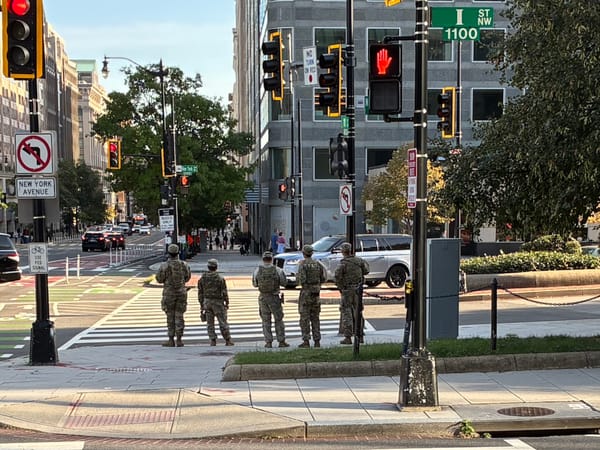
The ongoing federal court battles over President Trump's massive use of federal law enforcement and National Guard personnel for highly coercive and frequently violent immigration enforcement operations are a wakeup call.
His overtly political tactic of calling up National Guard troops from politically “red” states for deployment to “blue” jurisdictions for pretextual immigration enforcement, submission by intimidation, and crime control operations not only worsens political polarization, it undermines military readiness, morale, and recruitment and retention.
Trump’s attempts to use a specific Title 10 authority, and potentially even the Insurrection Act, for this purpose – over the objections of the leaders of the targeted jurisdictions (so far, California, D.C., Oregon, and Illinois) – are why Congress must take action to bar the practice.
Specifically, any constitutional amendment that takes the domestic law enforcement power away from the president should also include explicit language mandating the full and unconditional approval of any governor (or in the case of the District of Columbia, the mayor) for the peacetime federalized deployment of Guard personnel within or to their state. Absent that approval, the president would be barred from issuing such a call up of Guard personnel and could expend no federal funds for that purpose. The amendment would in no way change the president's ability to call up National Guard elements to meet external threats to the nation's security.
A Matter of Political Will...And Vision
A little more than 50 years ago, Richard Nixon’s legal transgressions resulted in a bipartisan impeachment vote in the House Judiciary Committee, followed by key GOP senators informing Nixon that his time in office was over. In contrast, since 2020 and with a tiny number of individual exceptions, House and Senate Republicans have refused to hold Trump accountable for his misconduct by using the constitutional and political tools available to them.
There were individual and notable exceptions, Liz Cheney and Adam Kinzinger being the most prominent. Eight of the ten House Republicans who did fulfill their oath to preserve, protect, and defend the Constitution from Trump have left office or been defeated in primary contest at Trump's behest--including Cheney and Kinzinger. And despite a string of new scandals less than a year into his second term, Trump maintains a de facto political stranglehold on Congressional Republicans.
Given the current Republican Party's role in making Trump's ongoing assault on the Republic possible, it seems the political power and drive for the kind of reform we need will likely have to come primarily from Democrats. The question of our time is whether or not that party has or can produce the kind of leaders who actually understand that the party's decades-long attachment to ever-expanding government power is why we now face an existential political crisis.
The loss of the bipartisan spirit in the defense of the constitutional order that drove Nixon from power is a problem that only an engaged electorate can address by sending men and women to Congress who have clear track records of putting the Republic ahead of partisanship.
Americans now face the very kind of domestic mortal threat to the Republic that Brutus and his Anti-Federalist brethren feared and predicted. Through his actions to date, Trump's constitutional predations have shredded the prior constitutional order. Whether the governmental system that comes after Trump is gone is better or worse than what came before him is up to us.
The hour is late, and much damage has already been done. But time remains to defeat the existing threat and create a new, better, and more durable rights-based constitutional order if we act with purpose, clarity of vision, and resolve.
REMINDER: You can get 30% off my new book about past episodes of unconstitutional surveillance and political repression, the Triumph of Fear, by going directly to the Georgetown University Press website and using the code TGUF...and this code can be used by anybody, so spread the word and thanks for being a Sentinel subscriber!