The FBI's Anti-Catholic Memo Was a Symptom. The Cure Won't Touch the Disease.
The Justice Department's fires eight people and calls the matter closed. The authority and mentality that produced the "Richmond Memo" is untouched—and it belongs to this FBI now.

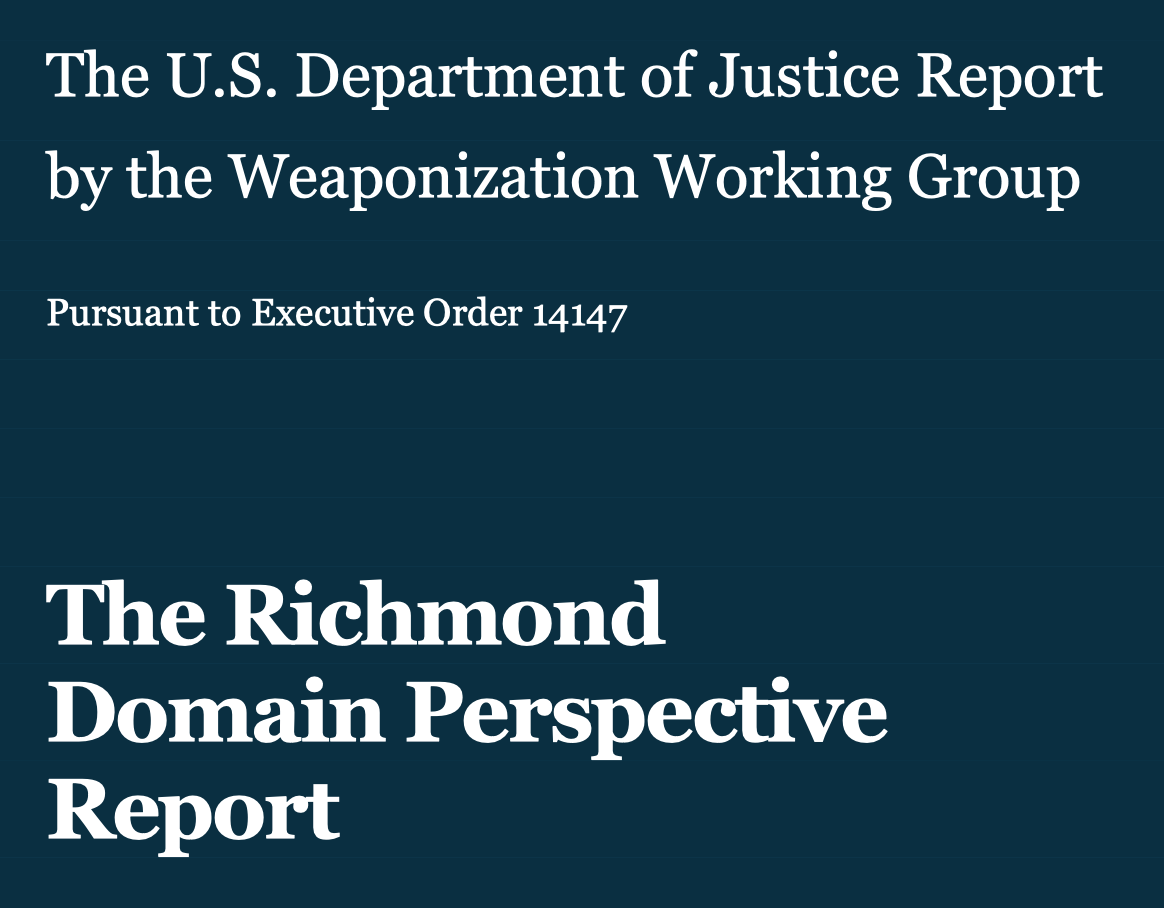
Last Friday, the Justice Department's so-called "Weaponization Working Group"—the review body President Trump created via Executive Order 14147—issued its account of the FBI's infamous 2023 "Richmond Memo." That was the internal intelligence product linking "radical-traditionalist Catholic" ideology to violent extremism and proposing to develop sources inside Catholic parishes. The report is detailed and scathing— but on the question that actually matters, absolutely silent.
The core claim and outcome: eight FBI employees exercised bad judgment and have now been fired. Its framing is that this was Biden-era weaponization but provides no evidence that anyone at the Biden White House was in any way involved with the Richmond field office report. That's because the incentive that produced the "Richmond Memo" was bureaucratic, not political, in character.
In September 2022, an FBI Richmond analyst proposed three possible "Domain
Perspectives" for Fiscal year 2023–which the WWG report characterizes as an "internal FBI intelligence products intended to highlight trends in an FBI office’s area of responsibility, such as different types of violent or criminal activity, intelligence gaps, and opportunities for research. Their purpose is to raise awareness within the FBI."
One concerned a state data-privacy law. One concerned violent-crime initiatives. The third, on "rad-trad Catholics," the analyst described as "a direct outgrowth" of a single case—and admitted its feasibility depended on "finding sufficient additional evidence."
That is the story in a single sentence.
An analyst had a product to write and went looking for evidence to fill it. When the databases turned up only two more cases nationwide, the office reached for the Southern Poverty Law Center's "hate group" list to manufacture a trend.
This is not a story about anti-Catholic animus, whatever the press release says. The Justice Department's own inspector general, which investigated this same episode, found no evidence of religious bias in 2024. Indeed, the WWG report reproduced the IG's finding of "no malicious intent or improper purpose"—then announced terminations in its final line without reconciling the two.
The Trump Justice Department fired eight career FBI employees to avoid indicting the FBI as an institution. But the bureaucratic incentive structure that tells agents that to get ahead in the organization one must generate investigations and reports on Americans and their associations is what leads to things like the "Richmond Memo"--and worse.
Consider what that organizational machinery permitted.
To chase the memo's thesis, agents opened "assessments"—the FBI's lowest investigative tier, requiring no criminal predicate to initiate—on two priests. One assessment was predicated substantially on the priest's "publicly available sermons." Agents pulled his flight records and credit-card data, obtained his phone contents through a border search, and surveilled him at an airport. None of this required a judge, a warrant, or evidence of wrongdoing. None of it was aberrant. It was the assessment authority working as written.
And here is the fact the Working Group's report never mentions. In January 2026, the Government Accountability Office issued a report on the FBI's use of assessments from 2018 through 2024. The Bureau opened roughly 127,000 of them. Only about 14 percent of the Type I and II assessments, and 6 percent of Type III, ever converted into predicated investigations—meaning the overwhelming majority were opened and closed without establishing any criminal or national-security basis. And assessments designated "sensitive investigative matters"—the category covering religious organizations, political figures, journalists, and academics—converted to full investigations at roughly 48 percent, more than three times the overall rate.
Over six months before the WWG report was released, Congress's own auditors documented that the Richmond episode was and is not an outlier. It is the system's normal surveillance-and-rights-violating output, occasionally embarrassing enough to require a scapegoat.
A report serious about "weaponization" would have to deal with that finding. This one couldn't, because the assessment architecture that produced the "Richmond Memo" belongs now to Kash Patel's FBI, unchanged.
The Domain Perspective product line, the bureaucratic and career production incentives, the authority to open a religious-organization assessment on a priest's
sermons–all of this remains, so far as we know, just as it was three years ago. Sacking eight employees and declaring the problem solved while leaving every tool that created the problem functioning--day after day, in secret--is pure political sophistry.
This is the trap of partisan accountability. When the fault is defined as those people, under that president, the remedy is fire those people. The analysts who wrote the "Richmond Memo" received performance ratings from "Consistent" to "Exemplary" for handling a difficult threat, in the same review cycle they were admonished for the memo. The institution rewarded the behavior while the new political overlords punished the fallout.
The findings are not new. The Directorate of Intelligence and the Inspection Division reached the core conclusions—flawed sourcing, conflated ideology, the
appearance of religious targeting—in early 2023. The terminations came in June.
What is new is the packaging: a report of more than 200 pages, drawn from over
1,800 pages of internal records, released with a statement from the Associate
Attorney General calling the memo "a clear abuse of power" against
"conservative and religious beliefs."
That is a communications spin product, and its release date was a choice.
The WWG report's release fell roughly two months before a midterm election, onto a battleground map thick with exactly the voters the report is built to reach. Wisconsin, Michigan, Ohio, Pennsylvania, Maine—the Senate and House contests likeliest to decide control of Congress run through the industrial North and New England, the historic heartland of ethnic and Mass-attending Catholicism. The traditionalist communities the "Richmond Memo" actually touched—the SSPX and FSSP chapels—cluster in these same regions. An earlier Working Group report promised a further installment on the Richmond office's "day-to-day weaponization" against "conservative, practicing Catholics."
Reports released in sequence, for sustained media coverage through the fall, are not the rhythm of an investigation. They are the rhythm of a political campaign.
Whether the date was chosen for November or landed there by accident, the document performs the same function: it hands one party a grievance to run on and costs the regime that released it nothing.
A report willing to name the real culprit—the assessment authority that lets an agent open a file on a priest's sermons, the production quota that sends an analyst hunting for a religious threat to write up—would have implicated the FBI that Kash Patel runs today. It would have handed both parties something uncomfortable. Instead, it blames eight people who worked for the last administration and calls the matter closed. The shallowness and the timing are not two criticisms. They are one. The report cannot afford to tell the structural truth, because the structural truth does not fit on a yard sign.
There is a version of this report that would have mattered.
It would have proposed abolishing "Assessments" entirely to ensure that agents
could only open legitimately predicated investigations based on at least reasonable suspicion that a federal crime had been committed. It would have applied to every administration, because the danger is structural, not partisan.
Catholics were right to be alarmed by the "Richmond Memo" itself. They should be more alarmed that the government's official post-mortem treats the authority behind it as a keeper. The next target may not be a traditionalist parish. But there will be a next target, and the tools are all still there, being used every single day.